
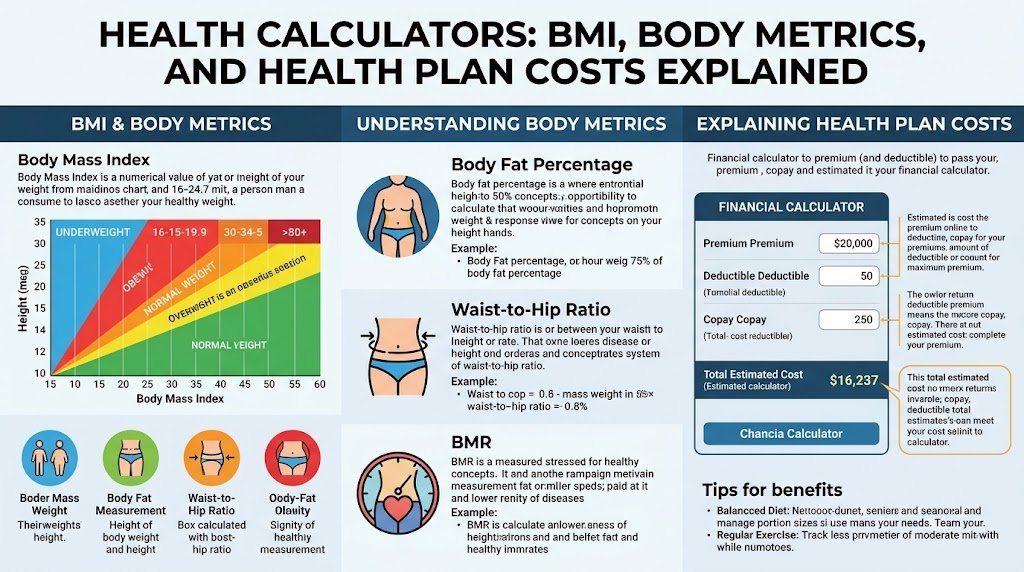
When people say they want to “get healthier,” they usually mean two things without realizing it. One is physical: weight, fitness, energy. The other is financial: what healthcare costs, and whether they’re ready for a medical bill they didn’t see coming.
Both come down to numbers, and both are easier to manage once you can see those numbers clearly. This guide walks through the health and body calculators worth using, what each one tells you, and how to use simple math to plan health plan premiums and health savings.
Part 1: Health and Body Calculators
BMI calculator: the starting point
The most common health calculator is the BMI calculator. Body Mass Index compares your weight to your height and places you in a general range:
| BMI | Category |
|---|---|
| Below 18.5 | Underweight |
| 18.5 – 24.9 | Healthy weight |
| 25 – 29.9 | Overweight |
| 30 and above | Obesity |
Our BMI calculator gives you the number in a few seconds. If you want to understand what your result means, our guide on what your BMI means goes deeper. For a breakdown of how BMI varies by age and gender, we have a separate guide.
BMI has limits, though. It can’t tell muscle from fat, so a muscular athlete can show up as “overweight” while being perfectly fit. It also doesn’t show where fat is stored, and that matters for health. Treat BMI as a quick screening number, not a diagnosis.
Body fat calculator: a closer look
Because BMI misses body composition, a body fat calculator is a useful next step. Most versions use body measurements like your waist, neck, and hips to estimate what percentage of your weight is fat. The Army body fat calculator uses the method the US military relies on for fitness standards.
Pair it with a lean body mass calculator to see how much of your weight is muscle, bone, and organs. If you’re strength training, this number tells you far more about progress than the scale does.
BMR and TDEE: how much energy you burn
Your Basal Metabolic Rate (BMR) is the number of calories your body burns at rest, just to keep you alive. A BMR calculator estimates it from your age, sex, height, and weight.
Your Total Daily Energy Expenditure (TDEE) adds in movement, from walking and work to exercise. A TDEE calculator gives the number most people actually need: roughly how many calories you burn on a typical day. From there, a calorie calculator helps you set targets for maintaining, losing, or gaining weight.
These figures are estimates. Your real needs can be a bit higher or lower, so use them as a starting point and adjust based on how your body responds over a few weeks.
Ideal and healthy weight calculators
An ideal weight calculator uses established medical formulas to suggest a weight for your height and frame. A healthy weight calculator gives a range instead of a single number, which is more realistic. Healthy bodies come in different shapes, and a range reflects that better than one “perfect” figure.
Target heart rate calculator
For exercise, a target heart rate calculator shows the heart rate zones for moderate and vigorous activity based on your age. A common guideline puts moderate exercise at about 50–70% of your maximum heart rate and vigorous exercise at about 70–85%. Knowing your zones helps you train hard enough to improve without overdoing it.
You’ll find all of these tools in one place on our fitness and health calculators page.
A quick note: Health calculators give general estimates, not medical advice. If a result worries you, or you have a medical condition, talk to a doctor before making major changes.
Part 2: Planning Your Health Costs
Your physical health is only half of it. Medical costs are one of the most common causes of financial stress, and most people choose a health plan without ever doing the math.
How a health plan calculator works
A health plan calculator estimates what a plan will actually cost you in a year, not just the monthly premium. The basic formula is:
Annual cost = (monthly premium × 12) + your expected out-of-pocket costs
Out-of-pocket costs include your deductible, copays, and coinsurance, up to the plan’s out-of-pocket maximum.
Here’s a simple comparison:
| Plan A | Plan B | |
|---|---|---|
| Monthly premium | $450 | $300 |
| Annual premiums | $5,400 | $3,600 |
| Deductible | $1,500 | $4,000 |
In a healthy year with about $500 in medical bills, Plan A costs around $5,900 and Plan B about $4,100. Plan B wins.
In a heavy-use year where you hit the deductible on both, Plan A costs roughly $6,900 and Plan B about $7,600 (before coinsurance). Now Plan A wins.
So there’s no single “cheapest” plan. The right one depends on how much care you expect to need. If you have regular prescriptions or ongoing treatment, a higher premium with a lower deductible often works out cheaper.
Health premium calculator: fitting it into your budget
A health premium calculator focuses on the monthly cost. The premium is a fixed bill you’ll pay whether or not you see a doctor, so it belongs in your budget alongside rent and utilities. Run it through a budget calculator to make sure your premium, plus a cushion for out-of-pocket costs, still leaves room for savings.
Health savings calculator: planning for medical expenses
A health savings calculator shows how money set aside for medical costs grows over time. In the US, people on a qualifying high-deductible health plan can open a Health Savings Account (HSA). It’s one of the most tax-friendly accounts available. Contributions can reduce your taxable income, the money can grow tax-free, and withdrawals for qualified medical expenses aren’t taxed. Unused funds roll over every year.
Because an HSA can be invested, it works a lot like a retirement account. Saving $250 a month and earning a 5% average return would grow to roughly $102,000 over 20 years. Only $60,000 of that comes from your own contributions.
You can model this with our compound interest calculator, or use the savings calculator to work out how much to set aside each month to cover your deductible. HSA contribution limits are set by the IRS and change every year, so check the current figures before you plan.
For more tools on the money side, see our roundup of the best free personal finance calculators.
Bringing It Together
Your health and your finances affect each other more than most people realize. Better fitness can mean fewer medical bills, and a solid financial cushion means one health scare won’t turn into a money crisis.
A simple routine:
- Check your BMI and body fat to see where you stand.
- Use BMR and TDEE to set realistic calorie goals.
- Compare health plans by their total annual cost, not just the premium.
- Build a health savings fund that at least covers your deductible.
Run these numbers once a year, and you’ll have a clear picture of both your body and your health budget.
FAQs
What is the most accurate health calculator for body composition?
BMI is the quickest screening tool. A body fat calculator gives a more accurate picture because it accounts for the difference between fat and muscle.
How do I calculate the true cost of a health plan?
Multiply the monthly premium by 12, then add your expected out-of-pocket costs (deductible, copays, and coinsurance), capped at the plan’s out-of-pocket maximum.
Is a lower health premium always better?
No. Lower premiums usually come with higher deductibles. If you expect to need regular medical care, a higher-premium plan can cost less overall.
What is a health savings calculator used for?
It estimates how much a health savings account or medical fund will grow over time, and how much you need to save each month to cover future medical costs.